Results
Fifteen photographs of the Plaza de la Virgen in Valencia: fourteen from a phone, and one undated one, a century older. The question is where the old one was taken from, and what has changed since.
The reconstruction, against COLMAP
Both configs register all fourteen modern photographs. The error is the angle between each camera's rotation and COLMAP's, after aligning the two models; the old photograph is scored apart, because it is placed by a different stage.
cpu |
gpu-dense |
|
|---|---|---|
| Cameras | 14 | 14 |
| Points | 2 850 | 2 830 |
| Mean rotation error | 0.338° | 0.300° |
| Worst camera | 1.328° | 1.336° |
| The old photograph | 1.32° | 0.60° |
The two differ because matching on a GPU and on a CPU does not give quite the same matches, and because COLMAP, which is the thing being measured against, reconstructs from scratch each time with its own randomness.
Every frame is a step of a real run: our cameras, COLMAP's, and the gap between them closing.
How far to trust that number
Not to the second decimal, and the honest reason is worth stating. COLMAP registers that one photograph in a second pass, from at best 32 matches, with nine unknowns and its own randomness: the same configuration has scored it 1.20°, 0.97° and 3.84° across runs, while the fourteen modern cameras agreed within 0.03°.
A difference of a degree on the old photograph is therefore inside the noise of what it is measured against. A difference of ten degrees was not, and there was one.
The 11.5° argument
For a long time our placement and COLMAP's disagreed by 11.5°, while agreeing within 0.8° on every modern camera. The disagreement turned out not to be a misplacement but a trade: on a nearly planar facade, tilting a camera up and shifting its principal point down project almost alike. Our DLT let the principal point go where the pixels wanted it; COLMAP pinned it at the centre of the image and had to tilt the camera up instead.
Two measurements settled which was right:
- The phones were all pointed slightly up. The fourteen camera centres are coplanar to within 0.7% of their own spread, which is what a flat square photographed from shoulder height looks like, so the normal of that plane is the vertical. Against it every phone looks up between 11 and 19°, as anyone photographing a facade does. Ours puts the old camera level; COLMAP, with the principal point pinned, had it looking up 11.2°, and the 11.5° between them was almost all pitch.
- A level camera with a low principal point is how architecture was photographed. A view camera's rising front shifts the lens up to take in a tall facade while keeping the verticals parallel, and a cropped print does the same. It is still a pinhole, only off-centre.
Freeing COLMAP's principal point for that one photograph brings the disagreement down to about a degree. The error was in the reference, not in the answer.
Which is why the colmap stage frees it, and why no number on this page is
scored against a pinned one. A model COLMAP computes here is placed with
ba_refine_principal_point on and every other frame held fixed; a model handed
to us with the query already pinned, as the course's was, has that one camera
refined before anything is measured, its pose and its intrinsics moving while
every other camera, every other pose and every point stay put. The stage prints
where the principal point went.
Refining the camera after RANSAC
RANSAC leaves a linear fit that minimises an algebraic error. Minimising the reprojection error itself, in pixels, under a Huber loss, over its inliers:
| Before | After | |
|---|---|---|
| Reprojection, median over 20 seeds | 14.1 px | 2.0 px |
| Spread of the camera's centre over those seeds | 0.235 | 0.031 |
The instability is what mattered: eleven unknowns from a handful of correspondences used to land somewhere slightly different on every seed.
The bundle adjustment
The original solver was scipy.optimize.least_squares. Writing one for this
problem (Levenberg–Marquardt, an analytic Jacobian checked against central
differences to 1e-8, the points eliminated with the Schur complement, the
6N−7 camera system solved directly, stopping at Ceres's function tolerance):
| scipy | ours | |
|---|---|---|
| Bundle adjustments, summed | 203 s (5.5 to 41.5 s each) | 3.5 s (0.1 to 0.9 s) |
Whole run from verify |
4 min 20 s | 25 s |
| Mean rotation error | 0.981° | 0.875° |
And the reason the accuracy moved as well as the speed: scipy's solve never converged. On every bundle it used up its evaluation budget and stopped; ours converges in 27 to 55 Jacobians, and reaches a lower robust cost (67 983 against 72 097 on the final bundle). The published 0.981° had been a bundle stopped short, and so were the thresholds that had been tuned against it.
scipy's solver is still there, as sfm.bundle_solver: scipy, because a claim
like that ought to be re-runnable.
The thresholds were searched, not guessed
Three numbers decide how much the reconstruction admits: pnp_threshold, how
far a projection may fall from its keypoint and still count when a camera is
registered; min_triangulation_angle_deg, how much parallax a pair of rays
needs before their intersection is trusted; and max_reprojection_error, how
far a point may sit from where it projects before it is thrown away.
They were chosen by running the reconstruction over a grid of combinations and scoring each against COLMAP, because the first search returned two results that no amount of local reasoning would have produced.
A tighter reprojection threshold is worse, not safer. Discarding a point because it does not yet fit also discards the correspondence a later bundle adjustment would have used to pull it into line, and the next camera is left with less to register against. Averaged across the grid, 3.0 px registered six cameras; 12.0 px registered 7.7.
The triangulation angle is not monotonic. Raising it from 0.5° to 2.0° increased the cameras registered, from 6.0 to 7.9: points triangulated from near-parallel rays have badly conditioned depth, and admitting them corrupts the pose of every camera that later leans on them. Raising it further to 4.0° dropped back to 7.1: now genuinely useful points were being refused. There is an optimum, and it is at neither end.
Both are the same lesson. In an incremental pipeline the cost of a decision is paid downstream of where it is made, which is what puts these thresholds out of reach of argument and makes an hour of compute the cheaper answer.
Searched again when everything around them had changed (2026-09-12): the EXIF K, the Schur solver, five more photographs, fourteen cameras instead of nine. Sixty-four combinations this time, since a reconstruction now takes seconds. The chosen values came out as good as anything on the grid.
pnp |
angle | reproj | cameras | points | mean rotation |
|---|---|---|---|---|---|
| 6.0 | 4.0 | 12.0 | 14 | 2668 | 0.326° |
| 9.0 | 4.0 | 12.0 | 14 | 2668 | 0.327° |
| 6.0 | 2.0 | 12.0 | 14 | 2849 | 0.341° |
The one combination that beats the current settings does so by 0.015° and 181 fewer points. At that distance the ranking is noise and the points are worth keeping, so nothing changed.
What the second search added: above 6.0 the PnP threshold stops mattering: 6.0, 9.0 and 12.0 all register every camera and score within 0.002° of each other, while 3.0 never manages more than thirteen. And the triangulation angle no longer decides anything, because with fourteen photographs every value from 0.5° to 4.0° registers them all. The optimum the first search found was a feature of a nine-camera graph, where a single badly conditioned point could still poison a pose.
What changed in the square
The old photograph warped onto today's, and the difference in tone once the two are matched: the lamp posts have moved, the arcade now opens onto a courtyard, a building beside the cathedral is gone, and the people are in both but never in the same place.
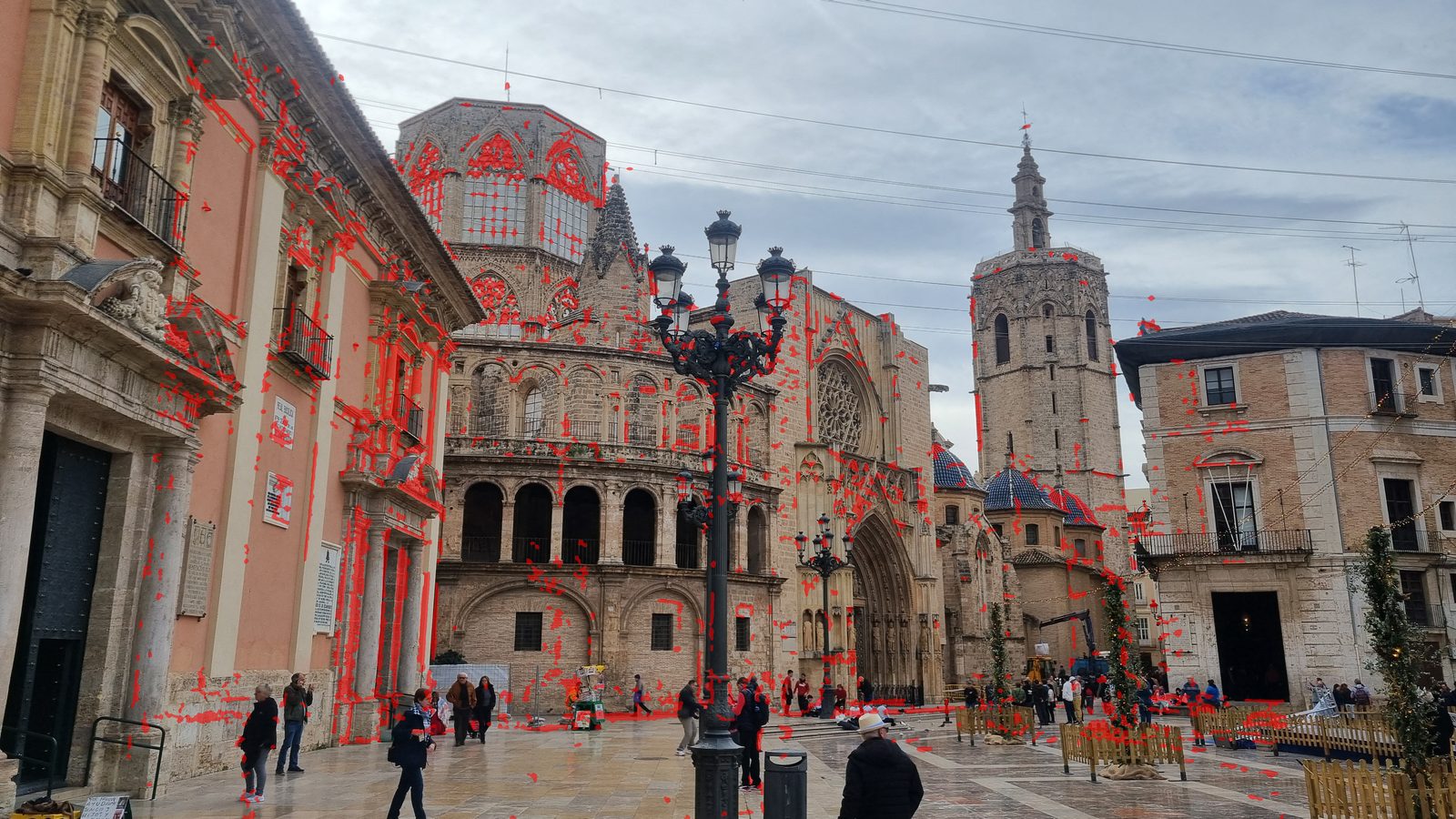
7.6% of the overlap is flagged as changed. Most of that is the square's floor and its passers-by; the cathedral itself, minus one building, is where it was.
How far the figure can be read. A homography aligns one plane exactly and nothing else. The cathedral's facade is near enough to flat, so what it flags there is change; the buildings down the sides of the square are at very different depths and register poorly, so much of what is marked there is misalignment instead. That is the method, not a fault in it, and the honest reading of the picture is that the facade is comparable and the flanks are not. Comparing them properly would mean warping through the model rather than through a plane, every pixel of the old photograph carried onto today's by the depth the reconstruction gives it.