What a run holds
A run is a directory per stage under projects/<name>/runs/<config>/. Everything in
it is reproducible from the config and the photographs, which is why runs/ is
not in version control, except the frozen runs runs/reference-* — one of each kind — which are.
projects/valencia/runs/gpu-dense/
├── calibrate/   K.txt, manifest.json
├── match/       Img01__Img02.npz …            one per pair
├── verify/      Img01__Img02.npz …            the same pairs, inliers only
├── reconstruct/ reconstruction.npz, reconstruction_before_refinement.npz, …
├── localize/    query_pose.npz
├── colmap/      cameras.txt, images.txt, points3D.txt, database.db
├── dense/       fused.ply
├── evaluate/    evaluation.json
├── changes/     overlay_Img_Old_on_Img01.png, changes_…png, score.png
└── figures/     comparison.png, cameras.png, matches_…png, …
Every stage writes a manifest
<stage>/manifest.json is the record of how that stage ran:
{
  "stage": "evaluate",
  "config_path": "projects/valencia/configs/gpu-dense.yaml",
  "timestamp": "2026-09-12T16:50:18.283605+00:00",
  "git_commit": "82e4ac97f2a1c7ebd6d876e292d406147f0440e8",
  "versions": {"sfmkit": "0.1.0", "numpy": "1.26.4", "scipy": "1.17.1", "python": "3.11.16"},
  "config": { "...": "the whole config, as loaded" },
  "mean_rotation_error_deg": 0.2998,
  "max_rotation_error_deg": 1.3360,
  "scale": 0.4589,
  "n_cameras": 14,
  "query_rotation_error_deg": 0.6037,
  "query_position_error": 0.0405
}
The commit is the code that produced the result — including inside an image, where it is baked in at build time — and the stage's own numbers sit beside it. That is what makes a figure in a paper traceable to a state of the repository.
The arrays
| File | Keys |
|---|---|
match/ImgA__ImgB.npz, verify/… |
keypoints of both images, the matches, and the verified subset |
reconstruct/reconstruction.npz |
K (3×3), image_names (N), rotations (N×3×3), translations (N×3), points (M×3), colors (M×3 uint8) when known |
localize/query_pose.npz |
R, t, and K when it was estimated |
dense/fused.ply |
COLMAP's fused cloud, binary PLY |
Poses are world to camera, x_cam = R X + t, in OpenCV's axes: x right, y
down, z forward. Points that failed to triangulate are NaN rather than
missing, so a point keeps its track's index for its whole life.
evaluate/evaluation.json
The scored comparison: the scale between the two models, the per-camera rotation and position errors after alignment, and the query apart from the rest, since it is placed by a different stage against a different reference.
The figures
sfmkit figures draws a finished run: the two models side by side
(cameras.png, comparison.png), and the diagnostics of the stages that got
there.
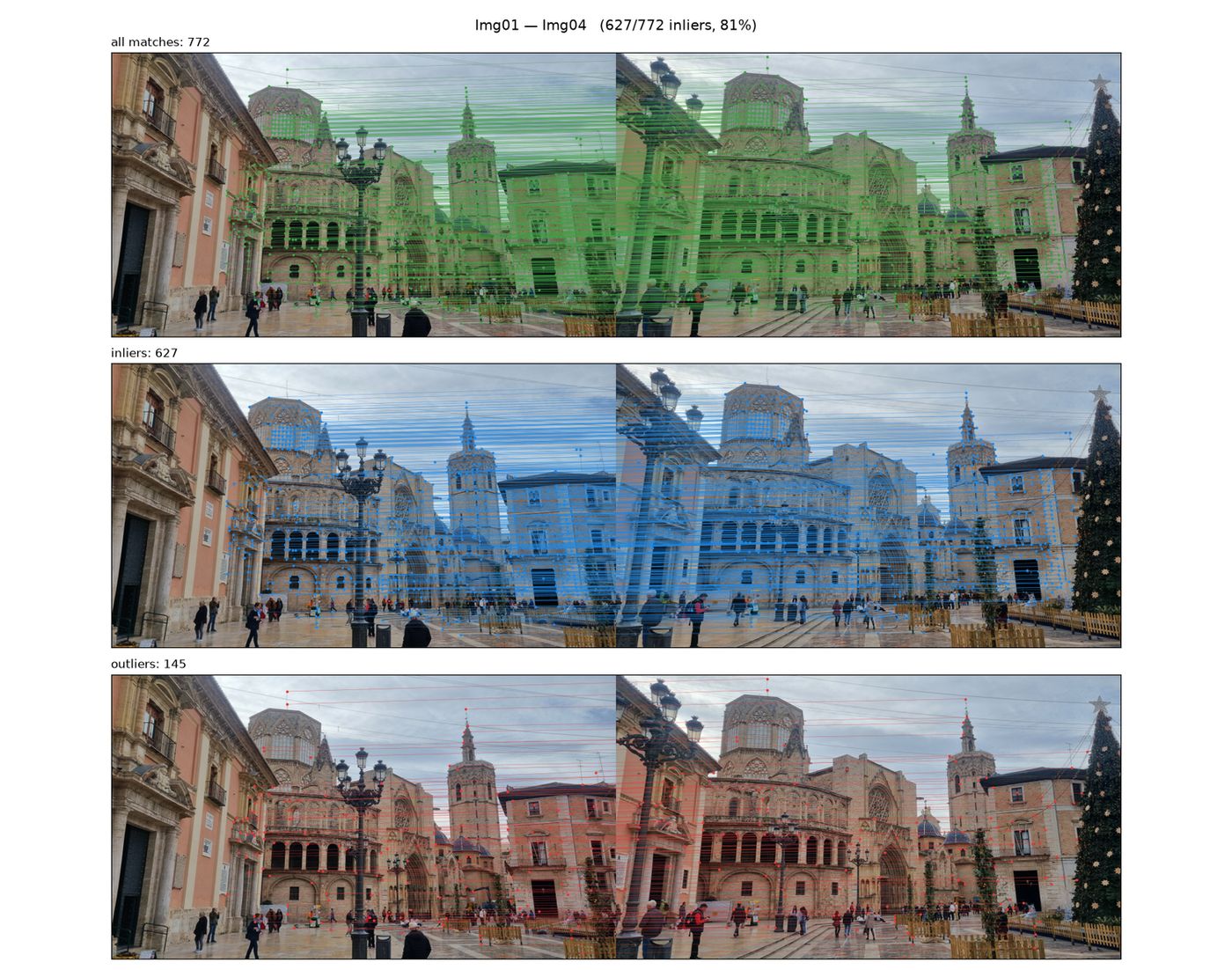
Img01-Img04: what the matcher produced, and what geometric verification
kept. The rejected matches are not scattered at random -- they gather in the
sky and on the repeated arcades, which is the signature of repeated structure
rather than of a matcher failing.
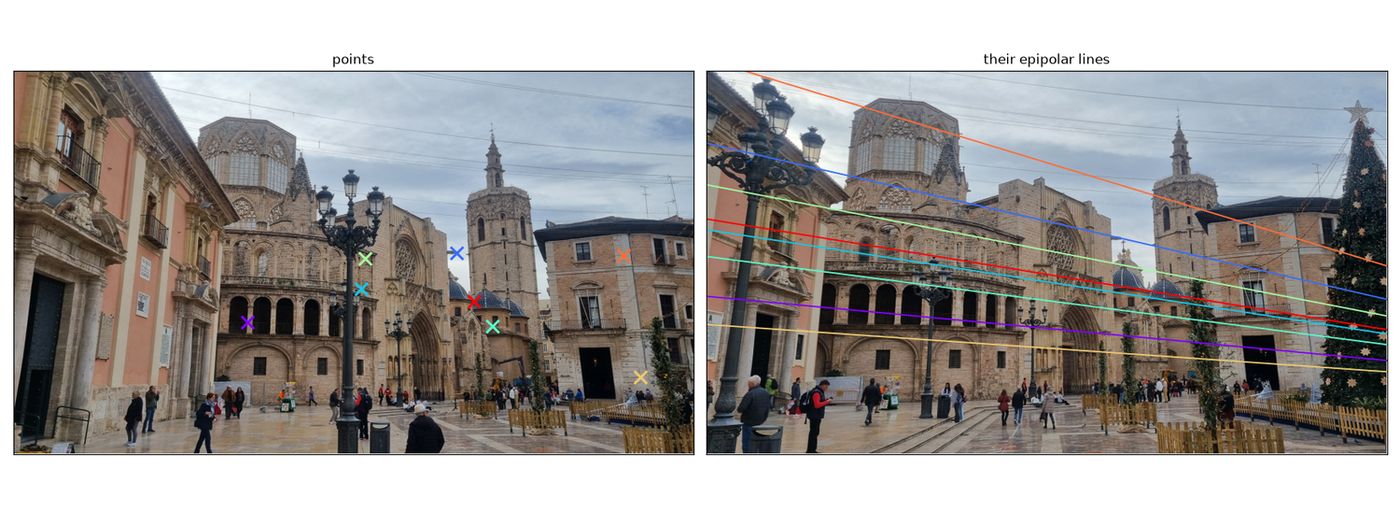
The epipolar geometry the verified pairs imply: a point in one photograph and the line it must lie on in the other.
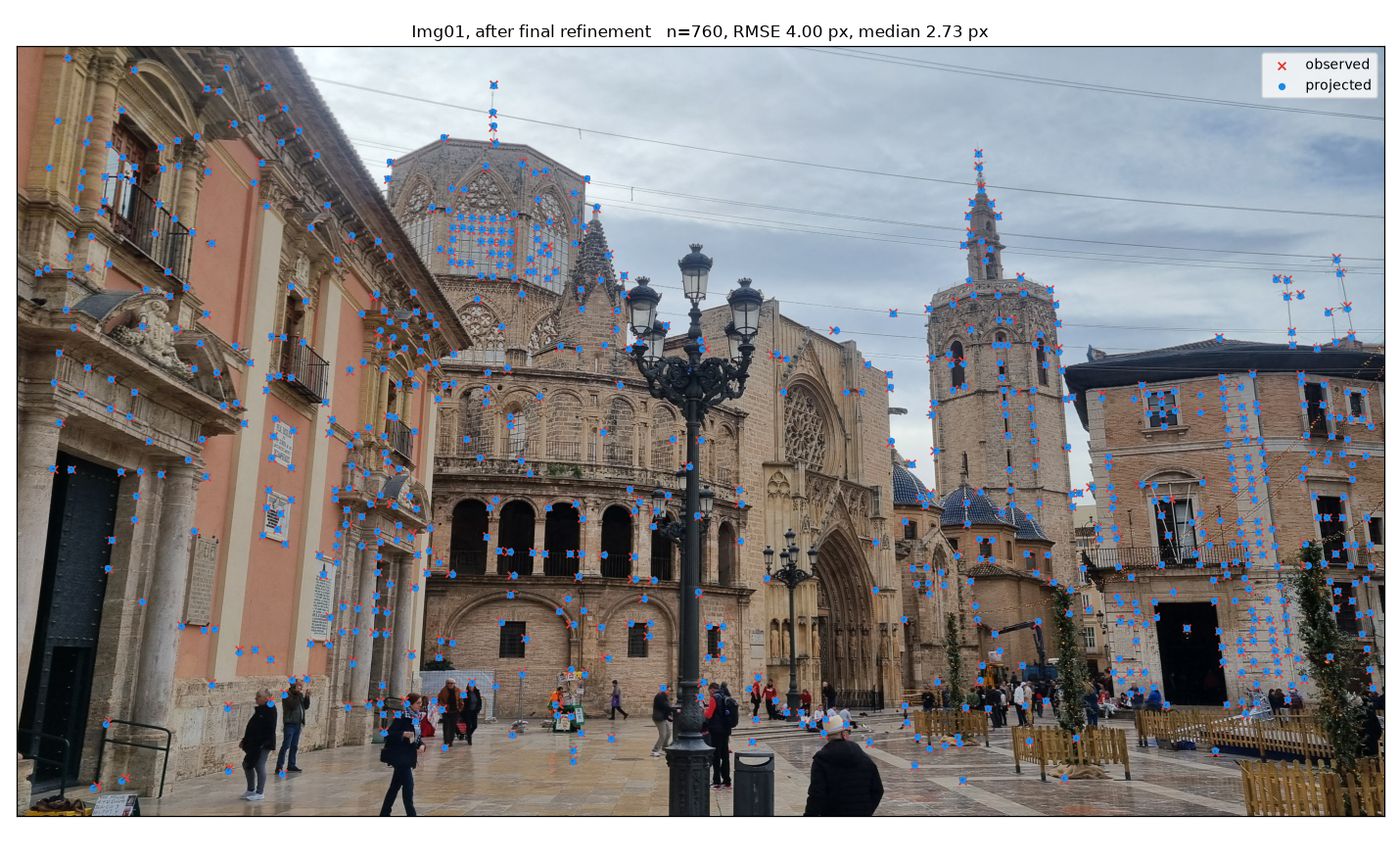
Where the reconstruction projects, against where the keypoints actually are.
There is also a before-and-after pair around the final global refinement, drawn
from two reconstructions that genuinely existed --
reconstruction_before_refinement.npz and reconstruction.npz. Expect little
between them: by that point a bundle adjustment has already run after every
camera, and most of the correction has been made.
Reading a run without sfmkit
The viewer does exactly that, through a fixed set of files —
the contract — and the same files
are what the figures and the reporting tools read. Nothing in a run needs
sfmkit installed to be understood: arrays in .npz, text from COLMAP, JSON for
the rest.