The pipeline
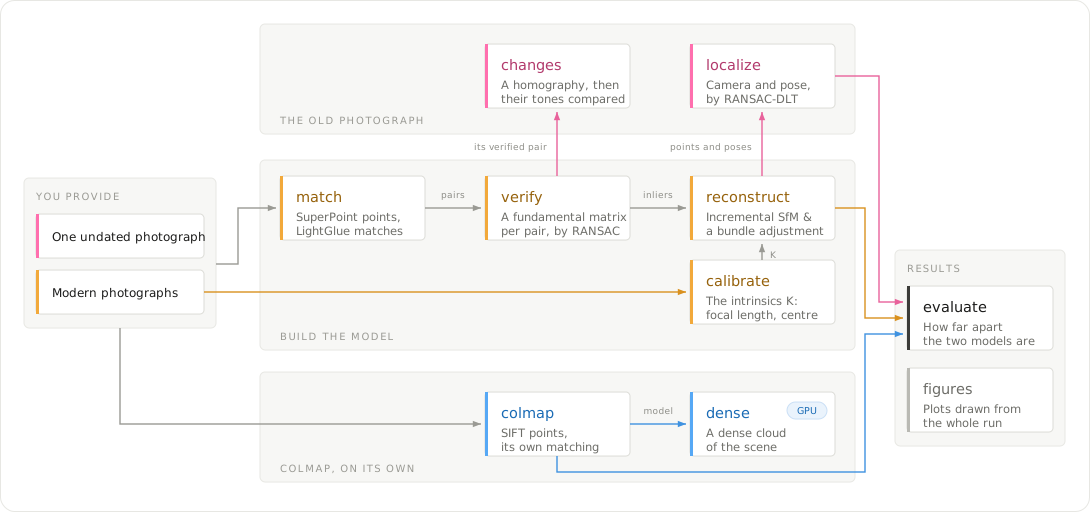
Ten stages, each a command. sfmkit run does them in order; any one of them
can be run on its own, because each reads what the one before it wrote.
The model being built: every frame is a real step of reconstruct, from the
seed pair to the global refinement.
What each stage does
| Stage | What it does | What it leaves |
|---|---|---|
calibrate |
The camera's focal length and image centre, without which nothing can be measured | K.txt |
match |
Distinctive points in each photograph, paired between photographs | a file per pair |
verify |
Throws away pairings that do not fit the geometry of two views | the same pairs, inliers only |
reconstruct |
Builds the 3D model: two photographs to start, then one at a time | the reconstruction |
localize |
Places the old photograph in that model | its pose and camera |
colmap |
The COLMAP model to be scored against | COLMAP's text model |
dense |
Optional, needs CUDA: a dense cloud from COLMAP's model | fused.ply |
evaluate |
How far every camera is from COLMAP's | evaluation.json |
changes |
Overlays the old photograph on a modern one and marks what differs | the overlay and the mask |
figures |
The plots for a finished run | figures/ |
Details of the options each one takes are in the CLI reference; the YAML that drives them, in Configuration.
How the reconstruction is built
reconstruct is the heart of it, and it works the way incremental SfM has
worked since Bundler.
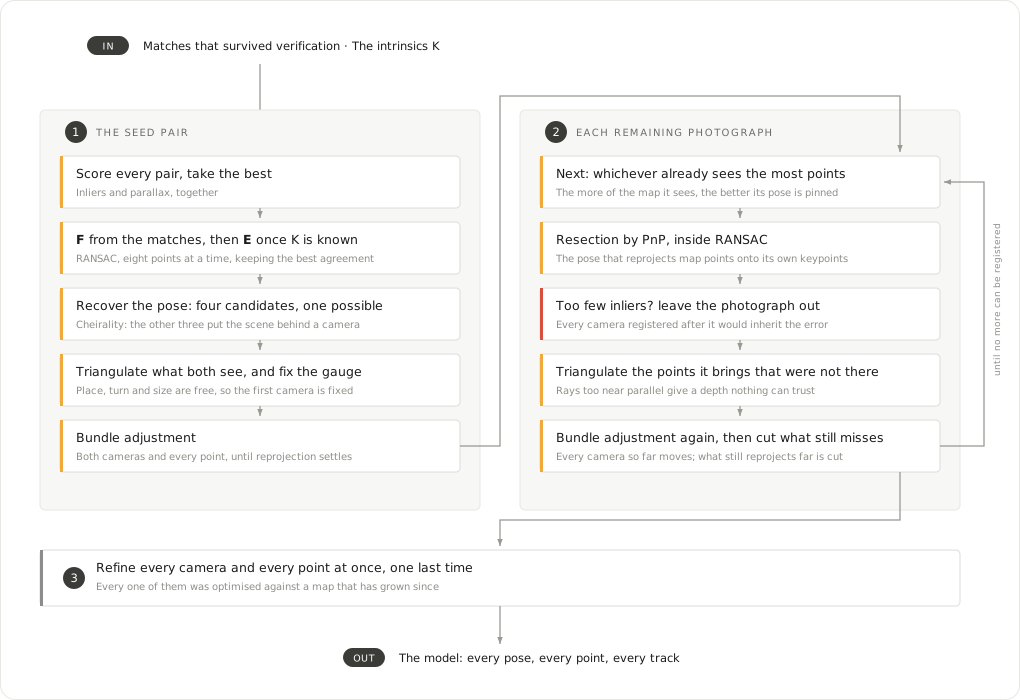
The loop is drawn as a loop: the seed pair happens once, the five steps beside it once per photograph. Every step names the idea it rests on rather than the function that carries it.
- An initial pair, chosen for the pair that has both enough inliers and a wide enough angle between the two cameras — a pair that is easy to match is often too shallow to triangulate.
- Triangulate what those two see, dropping points whose rays meet at too narrow an angle to be trusted.
- Register the next camera by PnP against the points already in the map, keeping the RANSAC inliers.
- Triangulate what it adds, filter observations that reproject too far, and bundle adjust: every camera and every point, minimising the reprojection error under a Huber loss.
- Repeat until no photograph can be registered, then refine globally once more.
The bundle adjustment is our own: Levenberg–Marquardt with an analytic
Jacobian, the Schur complement to eliminate the points, gauge fixed on the
first camera and the baseline of the second, and the robust loss applied as
iteratively reweighted least squares. It is about 58 times faster than the
scipy.optimize.least_squares version it replaced, which never converged on
these problems; that one is still there, as sfm.bundle_solver: scipy, because
a claim like this ought to be re-runnable.
The old photograph is handled apart
It was taken by another camera, of unknown focal length, perhaps cropped, a
century before the rest. So it is matched against the reference only, left out
of the reconstruction, placed against the finished model by localize, and
scored on its own. The old photograph opens localize
the way this page opens reconstruct, and Results has
what that cost and what it bought.