The old photograph
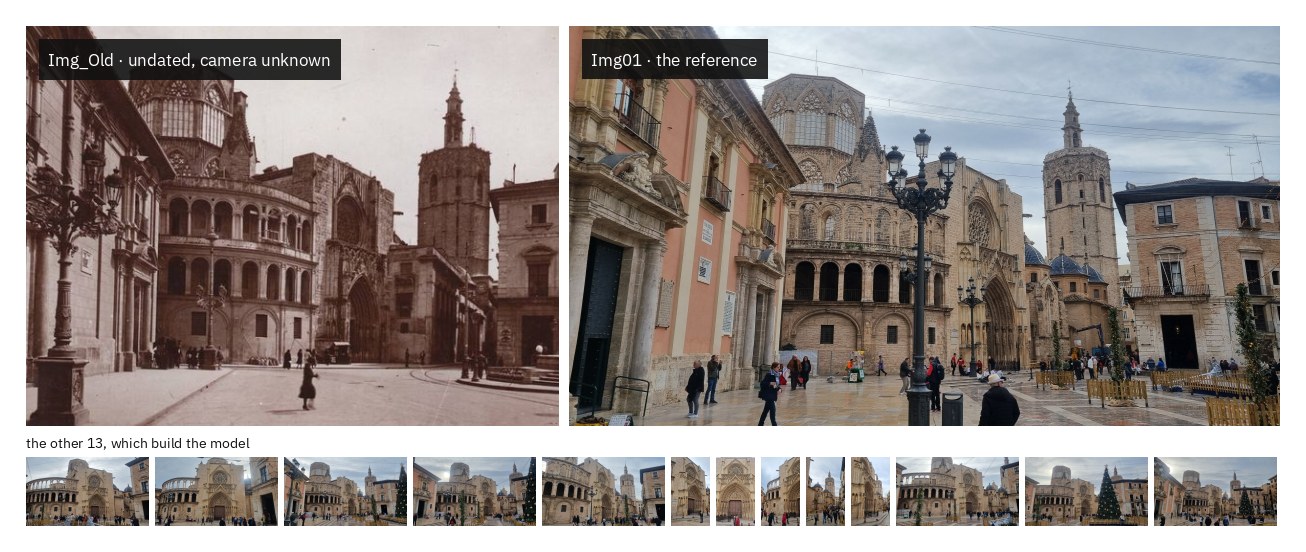
Where an undated photograph of the Plaza de la Virgen was taken from, and why the answer took some arguing. It is the deliverable of the project and the one image the pipeline treats differently at every stage.
Why it is handled apart
It was taken by another camera, of unknown focal length, perhaps cropped, a century before the rest. So:
| Stage | The fourteen modern photos | Img_Old, the old one |
|---|---|---|
match |
every pair | the reference only: it shares few features with any of them |
reconstruct |
registered | left out, so a shaky camera cannot bend the map |
localize |
— | placed against the finished map, its K estimated with its pose |
evaluate |
scored together | scored apart, against COLMAP's placement of it |
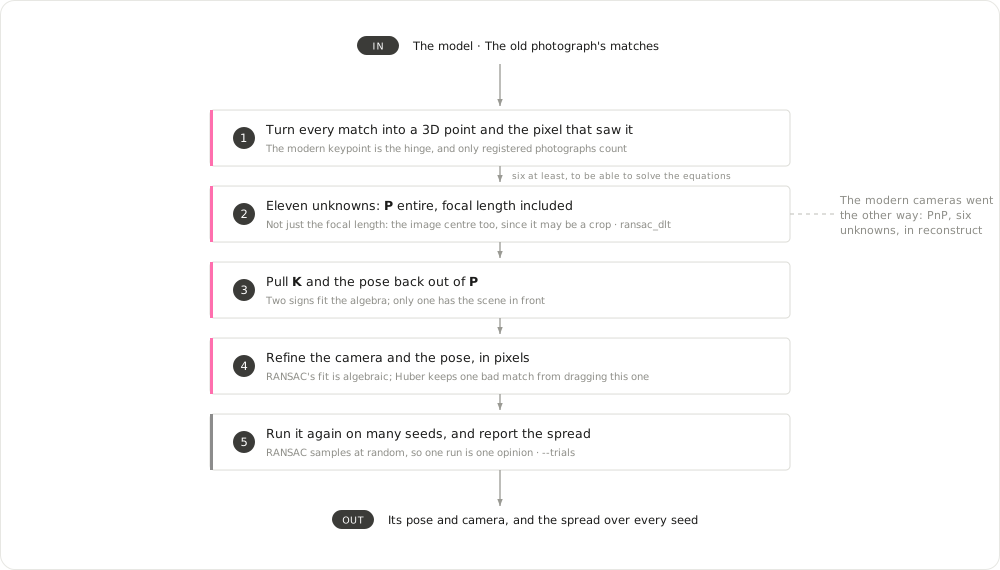
There is no branch here: the old camera is unknown, so the whole projection matrix is solved every time. PnP would assume the phone's calibration, which this photograph does not have.
The 11.5° argument
For a long time sfmkit's placement and COLMAP's disagreed by 11.5°, and it was not obvious which was wrong. They agreed within 0.8° on every modern camera.
The disagreement was not a misplacement but a trade. On a nearly planar facade, tilting a camera up and shifting its principal point down project almost alike. sfmkit's DLT let the principal point go where the pixels wanted it (241, 323 in a 557x418 image); COLMAP pinned it at the centre (278.5, 209) and had to tilt the camera up instead.
Two measurements settled it:
- The phones were all pointed slightly up. The vertical is the normal to the plane of the fourteen camera centres, which are coplanar to within 0.7% of their own spread: a flat square, photographed from shoulder height, so the plane is the ground and its normal is the vertical. Against it the fourteen look up between 11 and 19°, as anyone photographing a facade does. sfmkit puts the old camera level (pitch 0.2°, roll 2.0°); COLMAP, with the principal point pinned, had it looking up 11.2°, and the 11.5° between the two is almost all pitch.
- A level camera with a low principal point is how architecture was photographed. A view camera's rising front shifts the lens up to take in a tall facade while keeping the verticals parallel; a cropped print does the same. It is still a pinhole, only off-centre.
So the "error against COLMAP" was COLMAP's, for this photograph. COLMAP's query
pass now refines the principal point (ba_refine_principal_point, the scene's
cameras put back afterwards): it finds (241, 334) against localize's (241, 323),
the camera level, and the disagreement falls from 11.5° to about 1°. A model
made elsewhere with the point pinned — the course's — is refined the same way
by the colmap stage (refine_query), which takes its old photo from 11.9°
to 4.4°.
The camera it estimates
Nothing about that camera is known: not its focal length, not where its
principal point sits after whatever cropping the plate has had. All eleven
unknowns of the projection come out of the fit, which makes COLMAP's own
estimate for the same photograph the only check there is. On the cpu example,
where both place a 557x418 plate:
| fx | fy | principal point | |
|---|---|---|---|
| localize, refined | 552.0 | 555.8 | (238.0, 330.0) |
| COLMAP's query pass | 553.8 | 553.8 | (243.5, 332.0) |
Within 0.4% in focal length and six pixels in the centre, from two programs
that share the photographs and nothing else. The fit is free to return
whatever aspect ratio it likes -- COLMAP's SIMPLE_RADIAL is not -- and it
returns 0.7% away from square, which is the more telling of the two figures:
the course's pipeline, which assumed a K instead of estimating one, carried
fx = 27139 against fy = 7054 for this plate, a 3.8:1
camera with no physical meaning, and that is what its presentation was seeing
when it called the old camera "rotated a little bit weird".
What refining the camera bought
RANSAC leaves a linear fit that minimises an algebraic error. Minimising the pixels instead, under a Huber loss, over the inliers it found:
| Before | After | |
|---|---|---|
| Reprojection, median over 20 seeds | 14.1 px | 2.0 px |
| Spread of the camera's centre over those seeds | 0.235 | 0.031 |
Against COLMAP, cpu |
1.60° | 1.32° |
Against COLMAP, gpu-dense |
0.91° | 0.60° |
The instability is what mattered: eleven unknowns from a handful of correspondences used to land somewhere slightly different on every seed.
localize.refine chooses what moves: none, the pose alone, or the whole
camera, K included when K was estimated here.
How far to trust the number
Not to the second decimal. The reference itself moves: COLMAP registers this one photograph in a second pass, from at best 32 matches, with nine unknowns, and its own randomness. The same configuration has scored it 1.20°, 0.97° and 3.84° across runs, while the fourteen modern cameras agreed within 0.03°.
A difference of a degree on the old photograph is therefore within the noise of what it is measured against; a difference of ten degrees, as before, was not. To do better one would run COLMAP's query pass many times and report its spread, or compare both placements by their reprojection error on one neutral set of correspondences.